
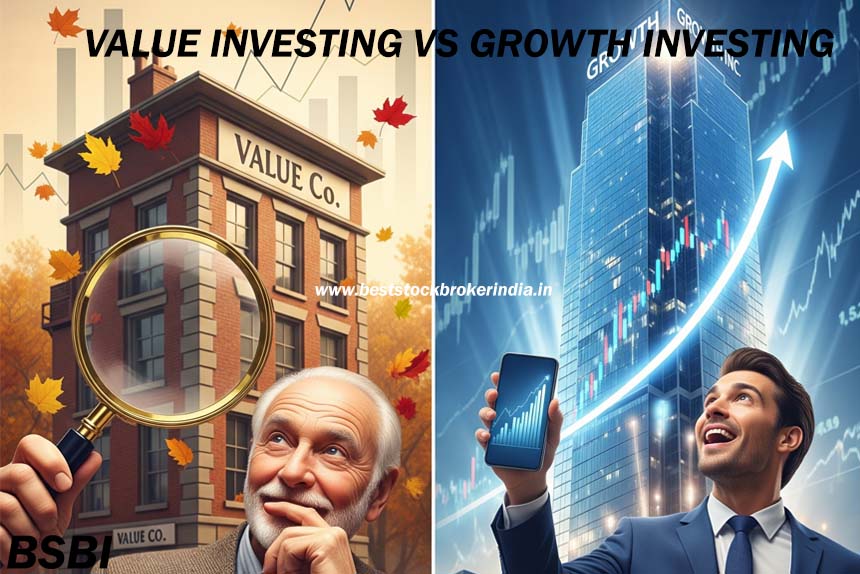

When it comes to stock market investing, two of the most popular strategies are Value Investing and Growth Investing. While both aim to generate wealth, they differ in approach, risk, and the kind of companies they target.
Understanding these differences can help you choose a strategy that suits your goals, risk appetite, and investment horizon. Let’s break down Value Investing vs Growth Investing in simple terms.
What is Value Investing?
Value investing is about finding undervalued stocks — companies whose market price is lower than their true (intrinsic) value. The idea is to buy them cheap and hold until the market realizes their worth.
- Focuses on fundamentals (earnings, book value, dividends, P/E ratio).
- Involves patience, as returns may take time.
- Popularized by legends like Warren Buffett and Benjamin Graham.
Example: Buying a strong FMCG or banking stock during a market correction because it’s trading below its intrinsic value.
What is Growth Investing?
Growth investing targets companies with high future potential, even if their current stock price looks expensive. These companies are expected to grow revenues and profits rapidly, often faster than the industry average.
- Focuses on future earnings and expansion potential.
- Involves higher risk but can deliver faster returns.
- Common in sectors like technology, e-commerce, and renewable energy.
Example: Investing in a fast-growing tech startup or electric vehicle company with huge growth potential.
Key Differences Between Value & Growth Investing
| Aspect | Value Investing | Growth Investing |
|---|---|---|
| Approach | Buy undervalued stocks at a discount | Buy high-potential stocks despite high valuations |
| Focus | Intrinsic value, fundamentals, safety margin | Earnings growth, innovation, future potential |
| Risk Level | Generally lower risk | Higher risk due to volatility |
| Returns | Moderate but stable, long-term | High potential returns, but less predictable |
| Time Horizon | Long-term, patient investing | Medium to long-term, faster growth |
| Examples | Blue-chip companies, dividend-paying stocks | Tech startups, emerging sectors |
Which Strategy is Right for You?
- Choose Value Investing if:
✅ You prefer stability over rapid gains
✅ You are patient and willing to wait for returns
✅ You want to minimize risk - Choose Growth Investing if:
✅ You have a higher risk appetite
✅ You want faster capital appreciation
✅ You believe in innovative, fast-growing sectors
Final Thoughts
Both Value Investing and Growth Investing can be profitable, but they require different mindsets. Value investors focus on patience and safety, while growth investors chase innovation and future potential.
The best strategy may be a balanced approach — mixing value stocks for stability with growth stocks for higher returns.
Remember: It’s not just about choosing value or growth, but aligning your investments with your financial goals and risk tolerance.