

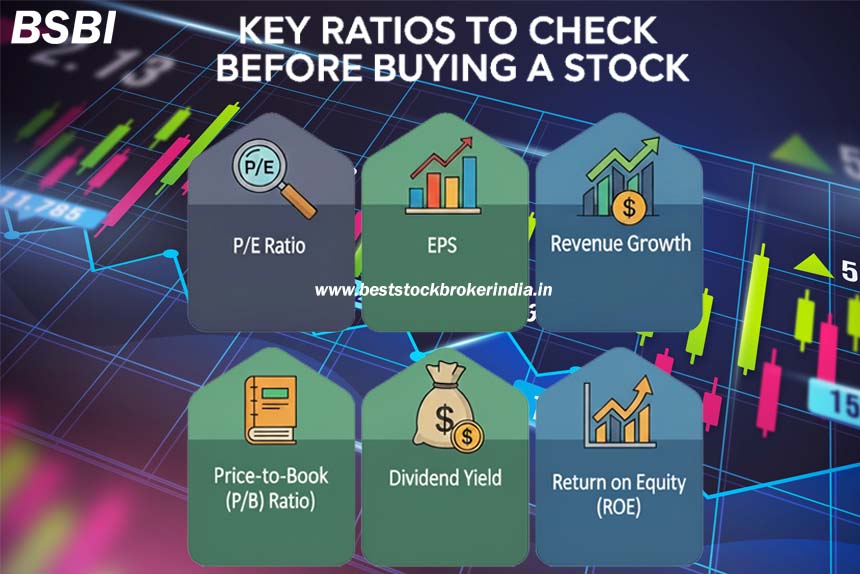

Investing in the stock market isn’t just about following tips or chasing trends. Smart investors look at a company’s financial health before buying its stock. One of the simplest ways to analyze a company is by checking key financial ratios.
These ratios help you understand profitability, valuation, debt, and overall performance. Let’s explore the 5 key ratios you should always check before buying a stock.
1. Price-to-Earnings (P/E) Ratio
- Formula: Market Price per Share ÷ Earnings per Share (EPS)
- What it shows: How much investors are willing to pay for ₹1 of earnings.
- Interpretation:
- High P/E → Stock may be overvalued (or have high growth expectations).
- Low P/E → Stock may be undervalued (or the company has weak growth prospects).
Use it to compare a company’s valuation with industry peers.
2. Price-to-Book (P/B) Ratio
- Formula: Market Price per Share ÷ Book Value per Share
- What it shows: Whether a stock is trading above or below its net asset value.
- Interpretation:
- P/B < 1 → Stock is undervalued.
- P/B > 1 → Stock is overvalued or has strong future potential.
Useful for analyzing banking and financial companies.
3. Debt-to-Equity (D/E) Ratio
- Formula: Total Debt ÷ Shareholder’s Equity
- What it shows: How much debt the company has compared to its equity.
- Interpretation:
- High D/E → Company is risky and highly leveraged.
- Low D/E → Company is financially stable.
Best for checking companies in capital-intensive industries like infrastructure, steel, or telecom.
4. Return on Equity (ROE)
- Formula: Net Profit ÷ Shareholder’s Equity × 100
- What it shows: How effectively the company is using shareholder money to generate profits.
- Interpretation:
- Higher ROE = Better profitability and efficient use of capital.
- Compare with peers in the same sector for accuracy.
5. Earnings Per Share (EPS)
- Formula: Net Profit ÷ Total Outstanding Shares
- What it shows: Profit allocated to each share of the company.
- Interpretation:
- Higher EPS → Better profitability.
- Consistently growing EPS → Healthy company growth.
EPS is a base metric used for calculating other ratios like P/E.
Final Thoughts
Before investing in any stock, checking these 5 key ratios — P/E, P/B, D/E, ROE, and EPS — can give you a solid understanding of the company’s financial strength.
- Value-focused investors can use P/E and P/B to find undervalued stocks.
- Risk-conscious investors should check D/E to avoid highly leveraged companies.
- Profitability-focused investors can rely on ROE and EPS growth trends.
Remember: Ratios should never be used in isolation. Always compare them with industry peers, past performance, and overall market conditions before making a decision.