

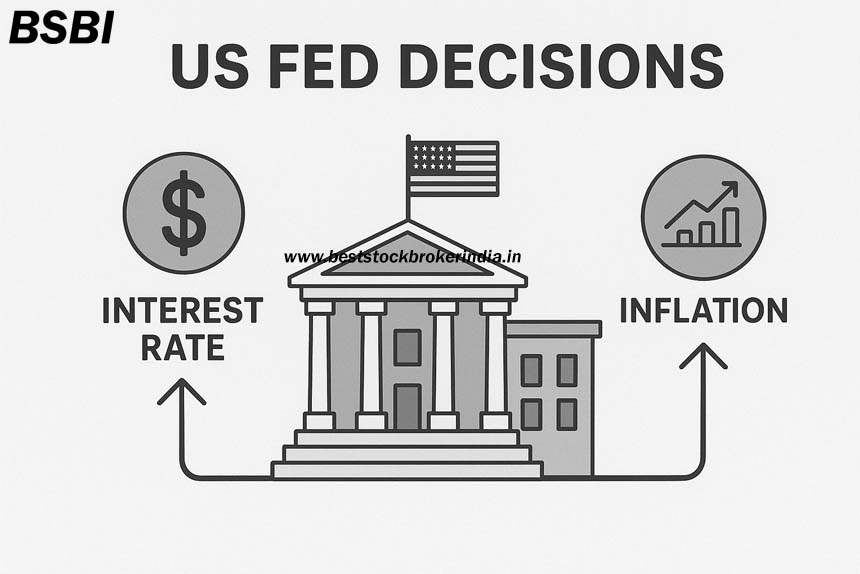

The US Federal Reserve (commonly known as the Fed) is the central bank of the United States, but its decisions don’t just impact America — they ripple across global markets, including India. For Indian investors, understanding the Fed’s policies is crucial, as it can influence everything from stock prices to currency movements.
In this blog, we’ll explore how the Fed’s decisions on interest rates, inflation, and liquidity affect the Indian stock market, bonds, and even your portfolio.
What Does the US Fed Do?
The Federal Reserve’s primary roles are:
- Controlling inflation (through interest rates)
- Ensuring employment growth
- Maintaining financial stability
Its most-watched tool is the Federal Funds Rate — the interest rate at which banks lend to each other. When the Fed raises or lowers rates, it changes the flow of money in the global financial system.
How Fed Decisions Impact Indian Markets
1. Impact on Foreign Investment (FII Flows)
- When the Fed raises interest rates, US bonds become more attractive. Foreign investors often pull money out of emerging markets like India and move it back to the US.
- This leads to FII (Foreign Institutional Investor) outflows, causing volatility in Indian equities.
- Conversely, when the Fed cuts rates, more foreign capital flows into India, boosting stocks and bonds.
2. Impact on Indian Rupee
- Higher US interest rates strengthen the US Dollar.
- As a result, the Indian Rupee tends to weaken, making imports (like crude oil) costlier.
- A weaker rupee also impacts companies dependent on imports but benefits exporters like IT and pharma.
3. Impact on Inflation & Commodity Prices
- A stronger dollar often leads to lower global commodity prices (like gold, oil, metals).
- For India, which imports a large portion of its crude oil, Fed decisions indirectly affect domestic inflation and fuel costs.
4. Impact on Indian Stock Market Sectors
- IT & Pharma: Benefit from a stronger dollar (since revenues are export-driven).
- Banking & Financials: Face challenges if FII outflows increase.
- Oil & Gas: Impacted by currency and global crude prices.
5. Impact on Indian Bond Market
- If US yields rise, Indian government bonds must offer higher yields to remain attractive.
- This pushes up domestic borrowing costs, which can affect corporate profitability and government finances.
Recent Example
When the Fed hiked rates aggressively in 2022–23 to fight inflation, Indian markets witnessed:
- FII outflows of billions of dollars.
- Rupee hitting record lows against the dollar.
- Increased volatility in stock indices (Nifty, Sensex).
However, once the Fed signaled a pause, FII inflows resumed, boosting Indian equities.
Final Thoughts
The Fed’s decisions act as a global financial domino effect — influencing liquidity, currency, and investment flows worldwide.
For Indian investors, the key takeaway is:
- Watch the Fed’s policy meetings closely.
- Expect short-term volatility around rate decisions.
- Long-term investors should focus on India’s domestic growth story, which remains strong.
In short, while the Fed’s moves may shake Indian markets in the short run, the fundamentals of the Indian economy continue to provide resilience and long-term opportunities.


